 English
 Arabic
 Chinese (Traditional)
 Khmer
Khmer Korean
 Punjabi
 Russian
 Somali
 Spanish
 Vietnamese
Below is our interview with the 2026 Washington State Teacher of the Year. Thanks to our friends at CSTP for helping us bring this Q&A to life!
To start, can you introduce yourself and share a little about your role at Pasco High School and the students you work with?
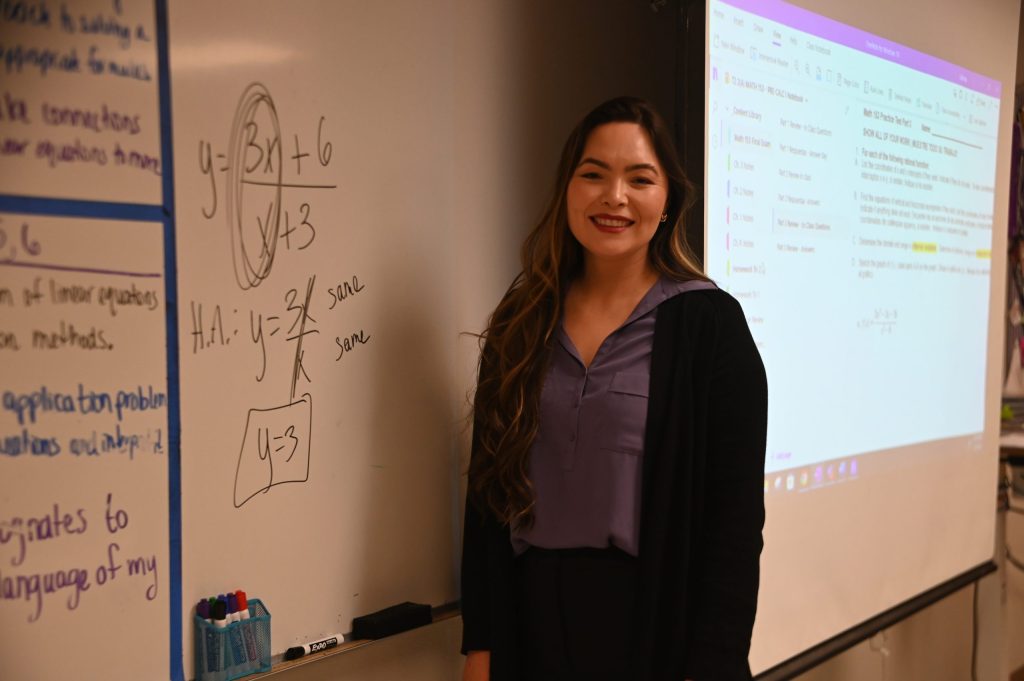 I am Gabriela Núñez Whitemarsh, the daughter of Mexican immigrants, a mother of two amazing teenagers, and the wife of a phenomenal middle school math teacher and coach. I am also the 2026 Washington State Teacher of the Year. It is my honor and privilege to work in and serve the community where I was raised—Pasco, Washington—and I am a proud product of the Pasco School District. Currently, I work as a bilingual mathematics teacher at the high school I graduated from, Pasco High School. Over the years, I have held several formal leadership roles and served on various committees, but currently my primary focus is working directly with students in the classroom, leading the Advanced Multilingual Mathematics Program and working with my colleagues to strengthen our instructional and community practices at our school.
The students I serve in my classroom are a mix of 9th through 12th grade students in College in the High School Precalculus, Algebra 1, and a 9th-grade AVID elective class. Over the years, I have taught various math courses but have always primarily worked with students who newly or recently arrived in the United States, and who speak Spanish as one of their home languages. This year, several of my classes include students from the general student body and the newcomer program. At our school, about 44% of our student population are multilingual learners and 8% are in our newcomer program.
You’ve spent nearly two decades teaching in both higher education and K–12 schools. What drew you to teaching mathematics, and what keeps you inspired in the classroom?
My earliest memories involve wanting to be a teacher, mostly inspired by my former teachers and by watching my parents always help others. I have always loved school, and helping people is at the core of who I am. In elementary school, my first- and fifth-grade teachers, in particular, advocated for me and taught my parents about the U.S. educational system so they, too, were able to speak up for me and my siblings. Thanks to my teachers, I was able to exit the Late-Exit Bilingual Program since Spanish is my first language and I learned English when I went to school. My first- and second-grade teacher, who taught me both years, fought and provided evidence demonstrating that I had acquired enough English to exit the bilingual program. At the time, my mom was a paraprofessional at a middle school in Pasco and was in college to become a teacher herself. My fifth-grade teacher advocated for me to be accepted into advanced or highly capable courses in middle school even though I failed the assessment by a few points. He was able to argue, using proof from my work in his classroom as well as my background as a multilingual learner, that I would be successful in advanced programs. Then, in high school, my math teacher advocated for me to enroll in AP Calculus when I was initially prevented from doing so.
These experiences coupled with my own love of helping others, teaching and tutoring, and the creative yet methodical nature of mathematics drew me to teaching it. As a student, I was always a helper in the classroom, and, in high school, I spent many days throughout the week tutoring friends and family, particularly in math.
Today, my students and my family keep me inspired. Witnessing their resilience, work ethic, and passion for constructing a better life for themselves and their families feeds my own desire to work hard and give my best for them. My parents came to this country to give us a better future. My dad, in particular, when he was 17 years old had a third-grade education, but he loved school. However, due to his circumstances, he was unable to attend and was in his mid-40s when he finally earned his GED – I was his tutor. So, in my classroom, when I welcome a new student who has experienced significant interrupted formal education and has to learn a new language, culture, and educational system, I think of my dad and the type of teacher I wish he had had. When I think about what my students have had to sacrifice to be here, the work I do for them feels small in comparison to what they have endured. As such, I strive to do more and be more for them.
You created the Advanced Multilingual Mathematics Program at Pasco High School. What inspired the program, and how does it help multilingual students access advanced coursework?
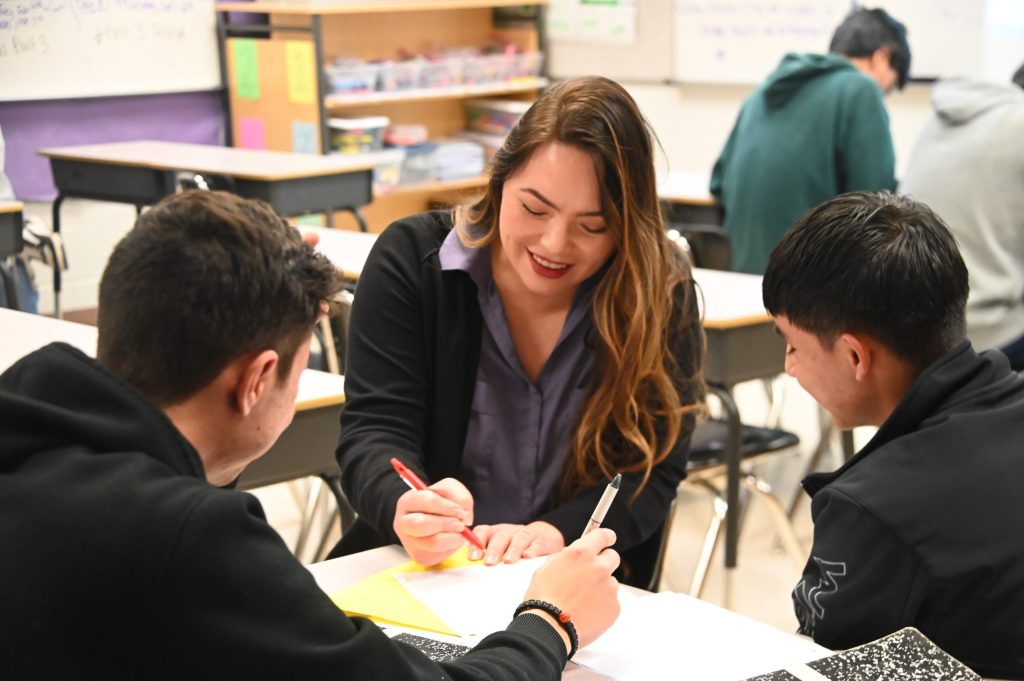 When I was a high school senior, I noticed there were very few bilingual students in advanced courses at my high school and vowed to change that. I left for college, built a career, and returned to my high school to teach, and the problem persisted. Specifically, our Newcomer students (newly arrived in the U.S.) could not access dual-credit courses until they learned English and could only access AP Spanish Language and Literature courses. My newcomer students were highly motivated, hard-working, and deserved an opportunity to take advanced courses and not be held back because of language. One student in particular—I wanted to nominate her for an award called the Golden Bulldog for math, but because she was not in advanced math, she was ineligible. That was the “gota que derramó el vaso” (the straw that broke the camel’s back). I began to realize how widespread this problem was and all the ways it was limiting opportunities for my students. So I turned anger into purpose, working towards a solution, and the program was born.
The program has grown and changed a lot since its inception in 2018. As it stands today, through a partnership I established early on with our feeder middle school who also houses a newcomer program, they now identify newcomer students who are ready for this next step and enroll them in their Algebra 1 classes with a bilingual math teacher. Prior to this, our district provided funding for the middle school newcomers to come to PHS to take Algebra 1 with one of us who taught the Algebra 1 class in Spanish for our newcomer students.
For those students who first arrive at Pasco High, they are identified through their newcomer math courses: first-year Algebra, Geometry, and second-year Algebra that are taught in Spanish. Then, depending on which math courses they have already earned high school credit in, they are funneled into the appropriate track. For those who are in Algebra 1, in their second year at PHS, they take both Geometry and second-year Algebra in the same year, so they have time to access Precalculus and Calculus prior to graduating high school.
Once they make it through the program to their Precalculus year, they come back to me and I teach the college-level class in a bilingual setting. At the end of this year, they can earn up to 10 college credits in math. Those who choose to move on earn another 10 college credits in Calculus the following year.
Many students in your program are both learning English and tackling rigorous math coursework. What strategies help students build confidence and succeed academically during that process?
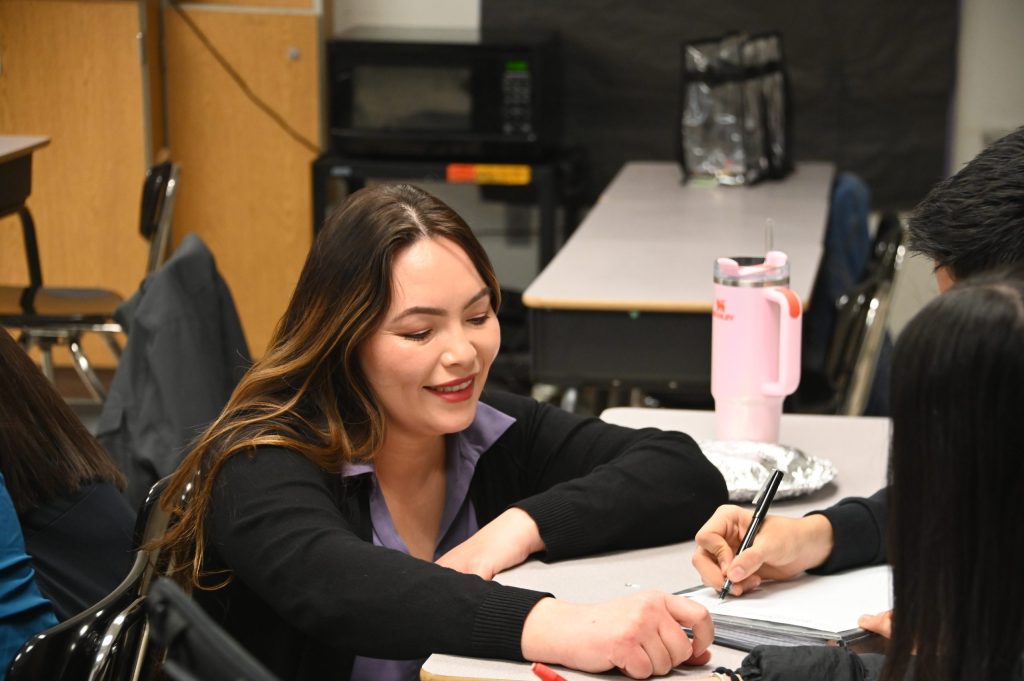
First and foremost, knowing your students is the most important aspect of teaching and the world of education, period. It is vital to understand how they think, what they care about, their goals and aspirations, what they like and dislike, learning about their lived experiences, all of that is important if you want to be an effective teacher. Kids need to know you care about them as people before they will trust you enough to learn from you. Once you learn what makes them tick, then you can incorporate a variety of teaching strategies to help convey the content.
Some of these strategies include: I use English and Spanish strategically during direct instruction, everyday conversations, and when setting the parameters and expectations for language use during learning activities. Additionally, I am a huge proponent of cooperative groups to respect and respond to our cultural norms. I also use color-chunking and coding to help build connections between current, past, and future concepts. Some other strategies include 10 minutes of teacher talk followed by 2 minutes of student or group processing time, building background knowledge to connect new concepts to lived experiences, and using teacher- and student-created input or anchor charts. I also use sentence frames and other strategies to help bridge English and Spanish while maintaining rigorous math content.
At first, their confidence will come from you as the teacher, but it is part of our work to help transition that so they see for themselves how capable they are. Again, this stems from building positive, safe, and healthy relationships.
How do programs like yours help ensure that multilingual students have access to the same advanced coursework and postsecondary opportunities as their peers?
Programs like the Advanced Multilingual Mathematics Program are purposefully built from identifying the inequitable systems that gatekeep students from historically marginalized communities from participating in advanced coursework, and reconstruct systems built specifically for them. This program is built in such a way that any student, regardless of educational background, has the opportunity to access and succeed in concurrent high school and college credit courses.
 For example, these are the barriers my students faced prior to the existence of this program to enrolling in advanced, college-credit coursework. The program was built from identifying these barriers and building a new structure where those barriers no longer existed or were relevant:
The barriers were multifaceted. 1) Students are tracked for advanced coursework in middle school and my students arrived in the U.S. in high school, so they missed that initial opportunity to “skip a grade” in math and be grouped with the advanced math students that were on track for dual-credit math opportunities. Their only opportunity was their senior year, but due to language, they were not aware nor were they being recruited to take these higher classes.
2) To earn college credit, students needed to place into the class using Accuplacer, which is only offered in English. So, I worked with the math liaisons of our collegiate partner, Central Washington University, and explained what I was trying to do. They offered another pathway, a memorandum of understanding, which is essentially a written recommendation from me for those students I believe will be successful. I must document their current and past success in math, work ethic, grades, and anything else that provides evidence for why I believe they will be successful, including how language plays a role in the results of the Accuplacer. They also gave me permission to translate the common math final so my students can fully demonstrate their understanding of the math content.
3) Courses taught completely in English – so our students who had the math background, work ethic, desire, etc. could not access the content even if they had the content foundation necessary for it. Students who were still in the early stages of learning English did not feel comfortable enrolling and they were not thought of to recruit because it always came back to language.
From your perspective as a teacher, how can high school classrooms help students see the connection between what they’re learning and their future education or careers?
I think this can be done in several ways. At its most basic level, it involves connecting what is happening in the classroom to something students are familiar with in real life. For example, if in Algebra you are teaching about linear equations and focusing on the concept of slope, you can ask students first about objects that have an incline or steepness. Have those ideas come from them, and they may say the roof of a house, or the incline of a road, ramp, or rollercoaster, etc. Then, you connect that to whose job it is to consider the steepness of those objects and what decisions they have to make or how do they make them? That example can lead to conversations about road construction work, engineers, roofing companies, home/office building builders, ADA compliance jobs, etc.
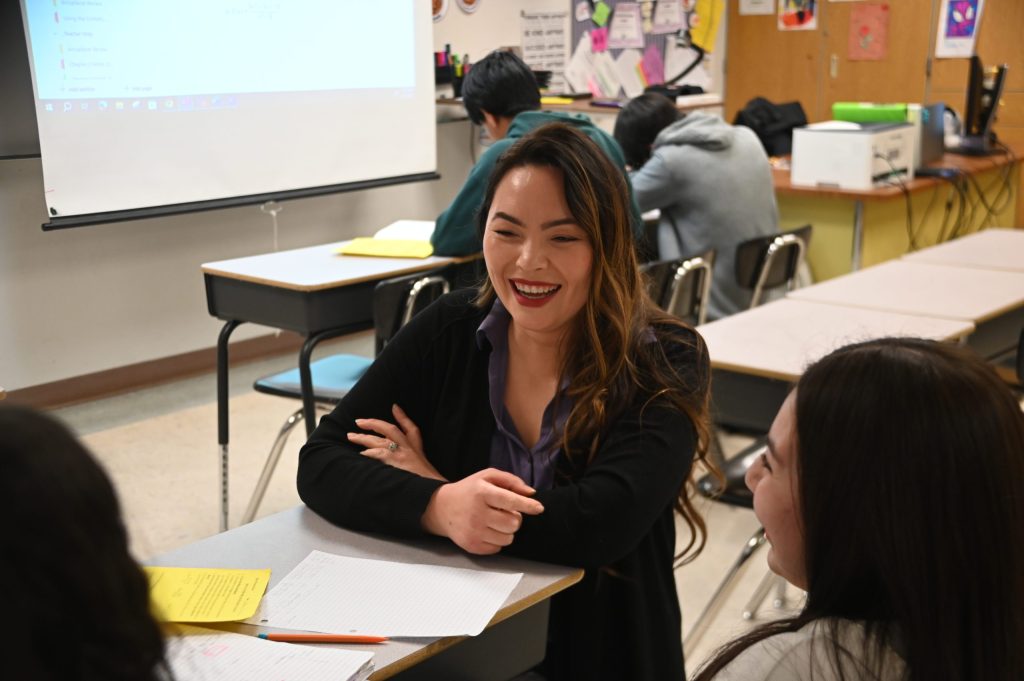 In addition, we use these algebra and/or foundational concepts to discuss how what they are learning now will connect to advanced coursework in the future. Returning to the example of slope, a constant rate of change, we discuss how understanding that concept for lines will help them when they apply a similar concept in Calculus to when they are finding instantaneous rates of change along any given point on a curve where the rates change. This builds connections between what they already know and experience in their everyday lives, to the math they are currently learning, to the math they will learn in the future.
As a last note, I have a colleague, who is the 2026 Tennessee Teacher of the Year who has built a platform around being able to connect every math lesson to a career, and often times ones that are local to her community. It’s very cool and very inspiring.
Many students benefit from dual credit and other opportunities to earn college credit in high school. How can educators help ensure these opportunities are accessible to students from all backgrounds?
It begins by looking honestly at who is accessing these courses/opportunities and who is not. Break down the data by demographic.
First, identify the process through which students access those opportunities and start from the earliest stages. For me, it started identifying that those systems began in elementary and middle school. Then, begin dismantling those barriers one by one with a group of like-minded colleagues, as well as others who may be resistant to change, since they can help identify roadblocks you may not see on your own.
Also, ask yourself what support structures need to be in place to help students succeed once they are participants in the newly designed system? Most importantly, it is important to note that the first version will not be the last, that mistakes will be made, but through a continuous cycle of analysis, reflection, redesign, and implementation, eventually, you will get it right. Furthermore, some of the people you anticipate will be with you fighting, may not have the courage or vision to help you. Likewise, those you think might be or are initially against it, may turn into your loudest supporters.
In your day-to-day teaching, what does educational equity look like, particularly when working with multilingual and newcomer students?
In my day-to-day practices, my personal challenge is always checking in with my feelings and reminding myself that my students, especially my multilingual and newcomer students, do not need nor benefit from my pity. They are the most resilient people I have ever met. Not just my multilingual and newcomer students, but any kid in today’s world. What they have access to, how they are judged by adults, and what is expected of them is a heavy load to bear. And yet, most days, they do it with grace, humor, and wit.
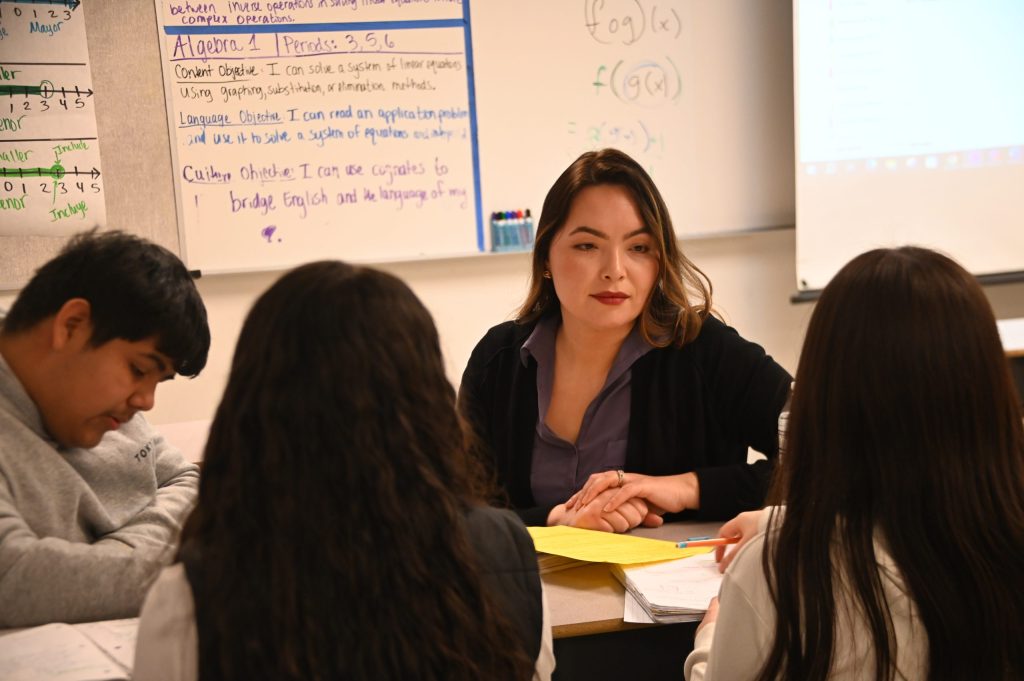 For my multilingual, newcomer students in algebra, I ask myself if my expectations for them are the same as for those in my advanced courses. And for those in my advanced courses, I always check in with myself ensuring my expectations for my newcomer students in these classes are the same as for my general education students in these same classes. I also ask myself whether I have created learning structures that provide the necessary background knowledge to build connections to new learning. This is also important because many times our curriculum assumes students have knowledge of common customs or traditions of the U.S., but those may be new to my students. In that case, I do two things. First, I adapt the context to one that is culturally responsive and reflective of my students’ backgrounds. Second, I expose them to that U.S. custom or tradition so they can learn about it and be familiar with it in the future. Furthermore, if I have students who have experienced significant interrupted education, I may have to adapt my entry task to incorporate reviewing a foundational skill they will need later that lesson to access the grade-level content. I also build in time so students can process learning in the language of their choice with themselves, their peers, and/or me, especially if that part of the lesson was primarily taught in English. Other aspects I reflect on in the moment include my rate of speech, as well as ensuring that I continue to use rigorous academic language and take the time to teach it, incorporate it, and provide time for them to practice using it.
Educational equity is understanding and putting into practice the fact that not all students need the same things at the same times. We need to continuously reflect and adapt, in the moment and after, to ensure our teaching practices reflect the needs of our students and take them to the highest levels of rigor and access we can. If my students do not understand something, I need to pause and check if it’s only my multilingual students, then I may have failed to scaffold for language. If it is most that are confused, then conceptually, I need to reteach in a way that is more relevant to them.
It is also important, though, to have grace for yourself. Not every lesson or every day will we be at our best, and that’s ok. What matters is that we reflect, learn, and try again tomorrow. What we can’t do is give up or have the attitude of “I taught it, it’s their job to learn it” and miss the fact that we have 30 unique brains and ways of processing information in front of us. Just as we each can watch the same movie, but we each experience it in a different way. Learning is the same as that. Our students have their own way of learning and to figure out what works best for them, we need to know them.
You served as the Multilingual Department Chair and Bilingual Facilitator and mentor both colleagues and students. What does leadership in education look like to you?
A couple years ago, I was both the Multilingual Department Chair and Bilingual Facilitator while I was teaching, but currently, I am in the classroom full-time. I chose to step back from those roles because it is my philosophy that teachers in positions of leadership should not hold onto those positions too tightly and need to let others grow and experience those opportunities as well. In my current role, I continue to lead and mentor, but without the title. I find joy and purpose in helping new teachers, especially, grow in their teaching practices and leadership skills as well. That includes conversations before or after school, in the hallway, or during meetings, checking in on how things are going and what they need. It means reminding them that they can succeed, that they have a lot to offer, and helping them problem-solve through different situations. It also involves offering constructive feedback when it is welcome, while recognizing both what is going well and where there are opportunities for improvement. Additionally, it includes helping plan lessons, following up afterward to reflect on how they went, and supporting them through the analysis and reflection process.
Being a leader also means leading by example, sharing what works for me as well as where I have struggled and how I addressed it. It is volunteering to be part of committees or taking on extra teaching responsibilities and not making the new teacher handle that on their own. It is also important to me to show what student and colleague advocacy looks like in practice. When a system, decision, or situation is not right or just, speaking up and encouraging others to do the same. That piece can be difficult, but if others see you do it, then it can help them find the courage to do so as well. That is especially true today, as our students and families are going through difficult and scary times and need us to speak up for them, take action, and teach them how to speak up for themselves.
What does being named 2026 Washington State Teacher of the Year mean to you, and what do you hope it highlights about the importance of supporting multilingual students in our schools?
Being named the 2026 Washington State Teacher of the Year was difficult because I can think of so many colleagues who are also deserving of this recognition. What has helped is the reminder that I am a representative of the work so many of us do and I hope to do them justice. On a personal note, it brings me great pride to represent so many important aspects of myself. I represent the sacrifices of my parents, my immediate family, and the immigrant community that has come before me and broken through barriers so I can be here today. In this aspect, I represent what happens when multiple people believe in, support, and uphold a child regardless of their background and see us as humans and not political pawns. I also represent my school district, where I was once a student and am now an employee, showcasing the amazing work we do.
As the 2026 Washington State Teacher of the Year, I am working to highlight how with the right perspective, work ethic, and collaboration, outdated and inequitable systems can be broken and rebuilt to serve the needs of your current community. I hope to highlight that change, even in deeply rooted systems, can begin with just one person, as long as you don’t give up or give in. My students come from some of the most marginalized communities, and yet, with equitable systems they are just as successful as anyone else. Our students deserve to be believed in, deserve a system that is built for them, and that they can succeed because of us educators and systems, not in spite of us. My hope is that we open our minds and our hearts and see the evidence that is out there, and they need look no further than the success of my students. Now, seven, almost eight years into this program, there are students who are about to graduate from college to become teachers themselves, who will serve communities across Washington state all because they were given access to opportunities they should have had all along.